
Career in Microbiology
Is biology your favourite subject? Would you like to study about small living organisms like bacteria, fungi, etc. ?
If yes, then you should consider a career in microbiology.
Microbiology is the study of the microorganisms that are not visible with the naked eyes. These microorganisms include bacteria, fungi, viruses etc. This field is the scientific study of these microorganisms. Here are examples of questions a microbiology researcher might ask:
- Which microbes help keep the human body healthy?
- Can this microbe be used to clean up pollution?
- What microbe made these animals sick?
- How can we keep this food product from spoiling?
This discipline includes fundamental research on the functional and clinical aspects of microorganisms.
Microbiologist work in various field of health care, pharmacology, biomedicine, genetics, food production technology, environmental protection and forensic science.
Examples:
- Bread is also an example of microbiology. Saccharomyces cerevisiae, also known as bakers yeast, is used in making bread.
- Curd is another example under this category. Lactic acid bacteria helps in the formation of curd.
What are the roles and responsibilities for Microbiologist?
- A Microbiologist examines physiological, morphological, and cultural characteristics.
- They use a microscope, to identify and classify microorganisms in human, water, and food specimens.
- Provide laboratory services for health departments for diagnosis and treatment.
- Investigate the relationship between organisms and disease, including the control of epidemics and the effects of antibiotics on microorganisms.
- Microbiologist research the use of bacteria and microorganisms to develop vitamins, antibiotics, amino acids, grain alcohol, sugars, and polymers.
- Develop new products and procedures for sterilization, food and pharmaceutical supply preservation, or microbial contamination detection.
- Prepare technical reports and recommendations based upon research outcomes.
- Monitor and perform tests on water, food, and the environment to detect harmful microorganisms or to obtain information about sources of pollution, contamination, or infection.
- Use a variety of specialized equipment such as electron microscopes, gas chromatography and high-pressure liquid chromatography.
- Observe action of microorganisms upon living tissues of plants, higher animals, and other microorganisms, and on dead organic matter.
- Study the structure and function of human, animal, and plant tissues, cells, pathogens and toxins.
- Microbiologist research the use of bacteria and microorganisms to develop vitamins, antibiotics, amino acids, grain alcohol, sugars, and polymers.
- Develop new products and procedures for sterilization, food and pharmaceutical supply preservation, or microbial contamination detection.
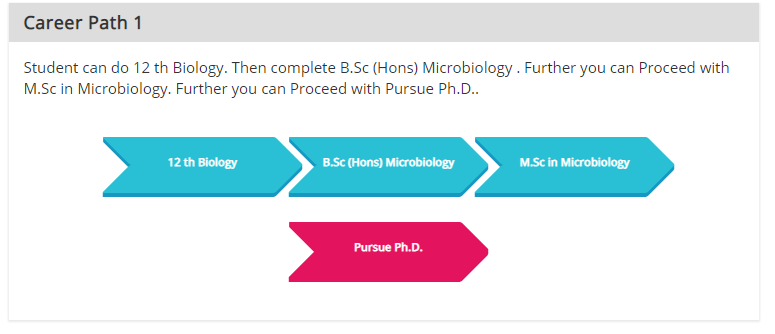
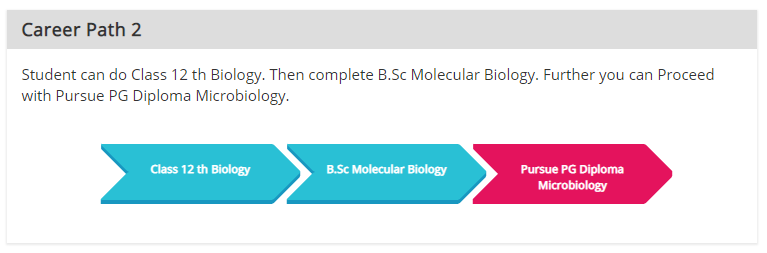
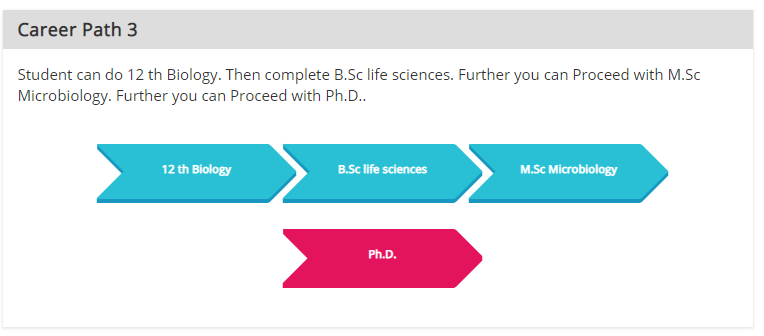
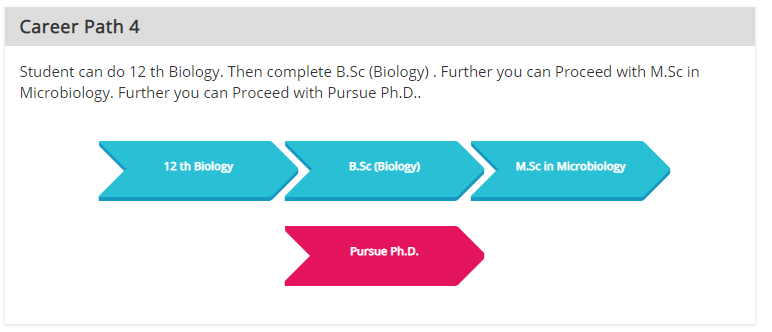
How to Become a Microbiologist in India?
There are 4 ways to become a Microbiologist in India
What are the key skills required for Microbiology?
- Molecular Biology
- Quality Control
- Research Analysis
What are the career opportunities in Microbiology?
- Clinical Laboratory Scientist
- Clinical Microbiologist
- Microbiological Analyst
- Microbiological Laboratory Technician
- Microbiologist
- Microbiology Director
- Microbiology Laboratory Manager
- Quality Control Microbiologist (QC Microbiologist)
- Study Director
- Bacteriologist
What is the salary and demand for Microbiologist?
- Demand is Medium for Microbiology.
- Salary levels are Medium for Microbiology. For fresher average salary is 3 to 4 Lacs.
- Fees levels of the course is Medium. To pursue this course student need to spend 3 to 4 Lakhs.
- Level of preparation for Microbiology is Medium. Students spend 1 Year. to prepare for entrance test of Microbiology.
What are the best colleges for Microbiology in India?
For Graduation
- St. Xavier’s College, Mumbai
- Madras Christian College – [MCC], Chennai
- The Oxford College of Science – [TOCS], Bangalore
- Fergusson College, Pune
- Mount Carmel College – [MCC], Bangalore
- St. Xavier’s College – [SXC], Kolkata
- Gargi College, New Delhi
- Elphinstone College, Mumbai
- Ethiraj College for Women, Chennai
- Scottish Church College, Kolkata
For Post Graduation
- St. Xavier’s College, Mumbai
- Madras Christian College – [MCC], Chennai
- The Oxford College of Science – [TOCS], Bangalore
- Fergusson College, Pune
- Presidency College, Chennai
- St. Xavier’s College – [SXC], Kolkata
- St Francis College for Women, Hyderabad
- Ramnarain Ruia College, Mumbai
- Ethiraj College for Women, Chennai
- AVVM Sri Pushpam College, Thanjavur
What are the best entrance exam for Microbiology in India?
For Graduation
- Osmania university Microbiology Entrance Exam-OUCET
- Goa University Microbiology Entrance Exam-Entrance Exam
- ?Mahatma Gandhi University Common Admission Test-MGU CAT
For Post Graduation
- Indian Institute of Science, Banglore-IIS
- INDIAN INSTITUTE OF TECHNOLOGY -IIT CAT
- Goa University Microbiology Entrance Exam-Entrance Exam
- Mahatma Gandhi University Microbiology Entrance Exam-MGU CAT